Month: April 2016

Reduced Tax Relief – Will It Affect You?

Attacks & More Tax !

In March the Chancellor announced tax changes for property investors. In this article we consider the effect of one of these changes ….. Reduced Tax Relief.

From 2017 the amount of tax relief that some landlords can claim on their finance costs (such as mortgage interest payments) is gradually being reduced. When the changes take full effect in the 2020/21 tax year, landlords will only be able to claim tax relief at the basic rate of 20%, instead of 40% or 45% for those in higher or top rate tax brackets, respectively.

The Current Rules
Currently as a landlord you can claim all of the interest-only part of your buy-to-let mortgage against the rental income generated from your property. So, if you’re in the 40% income tax bracket, your tax bill will be 40% of the difference between these two elements.
For example, let’s say your Crawley investment property generates £12000 pa in gross rental income. If you have a buy-to-let mortgage & pay interest of £9000 pa, your net profit will be £3000pa.

If you pay income tax at the basic rate of 20%, then you would owe the Revenue £600 i.e. 20% of £3000. If you’re in the 40% higher tax band, however, you would have to pay £1200 in tax i.e. 40% of your £3000 profit. Our example is summarised in Table 1.
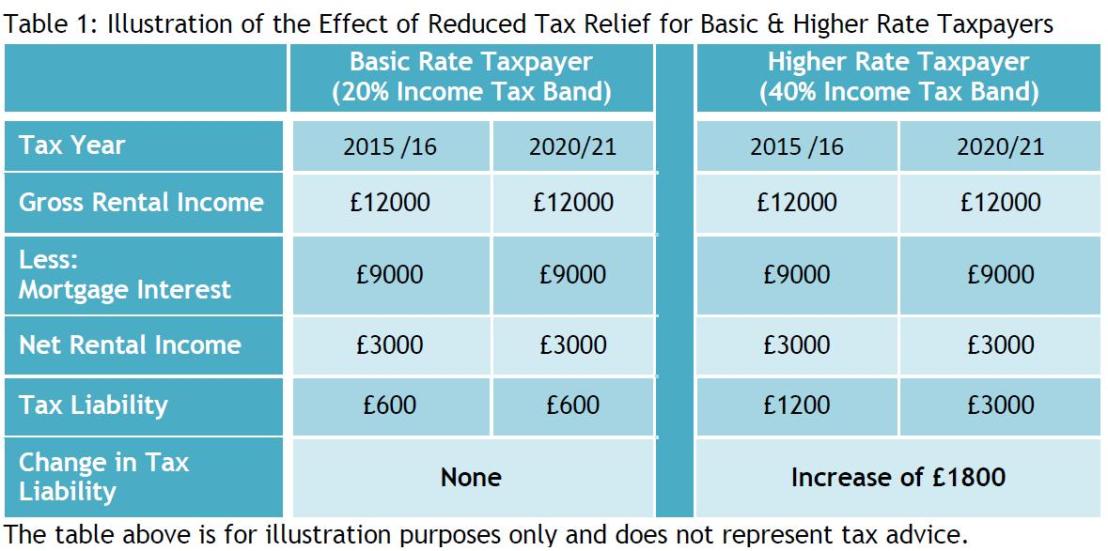
25-4-16 Table 1

New Tax Regime from 2017
By 2020/21, when the transition period for changes to tax relief are completed, you will only be able to deduct 20% of the mortgage interest from your tax liability. To illustrate the impact, let’s re-visit the previous example. Again, this is summarised in Table 1.

If you’re a basic rate tax payer, in 2020/21 your tax liability will still be £600 i.e. 20% of your £12000 rental income LESS 20% tax relief on your mortgage interest. So nothing changes.

Unfortunately, if you’re a higher rate tax payer you won’t be so lucky. As a taxpayer in the 40% income tax bracket, from 2020/21 onwards your rental income will be taxed at the rate of 40%, BUT your mortgage interest relief can only be deducted at the rate of 20%.

With reference to our previous example, if your rental income is £12000 pa, you’ll have to pay tax on this amount at the rate of 40% i.e. £4800. Although you will be able to deduct mortgage interest, in 2020/21 this can only be done at the basic rate of 20%. In our example this amounts to £1800. Hence your tax bill for the property in 2020/21 would be £3000. So you would be £1800 worse off compared with now.

Please note the above is not & should not be considered as tax advice. In order to obtain expert tax advice your should consult with a qualified accountant or tax advisor. They may be able to suggest ways in which you can reduce your tax liability.

The opinions expressed in this article are those of the author only and not of Northwood. If you are considering investing in property, please make sure that you seek appropriate professional advice.


12th April 2016

5%+ Rental Yield After Adding the Stamp Duty Surcharge ?

With the additional 3% Stamp Duty surcharge for second property purchases now set in stone, a number of property investors have been concerned about the effect on rental yields.

As we’ve argued previously, however, the Stamp Duty hike imposed by the Chancellor on the 1st April, has to be considered in the grand scheme of an overall property investment strategy – see https://wordpress.com/post/thecrawleypropertyblog.com/2740.  Most of the landlords that we know aim to keep their properties for the long term i.e. 10 years plus. This length of time is usually sufficient to “ride-out” the inevitable peaks and troughs associated with property prices. As one wag pointed out to me recently, however, it’s not the peaks that concern him……it’s more the troughs ! Point taken !

So, has the recent Stamp Duty surcharge torn the heart out of buy-to-let ?

From our perspective the answer to this question is currently no. Investment property is for the long haul, not just for Christmas – first mention of the C-word this year !  The 3% additional upfront purchase cost for buy-to-let investors is therefore more of an irritant than a game changer. Of course there are other tax changes that the Chancellor intends to phase in over the next few years, so advice from a qualified tax specialist is probably in order.

However, by way of an example, let’s take a look at a 2 bedroom flat in Southgate West, Crawley, that has just been advertised on Rightmove by estate agents Taylor Robinson. The asking price range is £210000 to £220000. Although the apartment block appears somewhat dated, from the internal photos the property looks to have been refurbished & maintained to a very high standard indeed. Here’s the Rightmove link for a closer look http://www.rightmove.co.uk/property-for-sale/property-53773372.html

Although the asking price for this flat is somewhat higher than similar properties that have sold recently, both the internal condition and seasonal effects of Spring on house prices have probably persuaded the vendors to try for as much as they can get – and why not !

Notwithstanding the higher price, 2 bedroom flats like the one we’re considering here rent for around £925 to £950 pcm. If, as a property investor you decided to add the additional Stamp Duty surcharge onto the purchase price to calculate your rental yield, you would get an effective asking price range from £216300 to £226600. Based on the rental values we’ve quoted, your gross rental yields would now effectively be around 4.9% to 5.3%. These yields are still slightly higher than the UK average at around 4.8%, as quoted for February 2016 by the Your Move and Reeds Rains Buy-to-Let Index – http://www.lslps.co.uk/news/house-price-index. Of course, if you can offset the Stamp Duty surcharge against any Capital Gain when you eventually sell, so much the better !

So there you go – it’s still possible to achieve 5% gross rental yields on Crawley investment properties, even if you add the Stamp Duty surcharge on to the asking price !

If you’re considering investing in property in or around the Crawley area and would like some advice on what & where to buy, please give us a call on 01293 515588. Our advice is free  and we’d love to chat “property” with you ! Alternatively, you can also e-mail us on crawley@northwooduk.com.

The opinions expressed in this article are those of the author only and not of Northwood. If you are considering investing in property, please make sure that you seek appropriate professional advice.